Showing posts with label finished pieces. Show all posts

Monday, September 22, 2014

Goddess Series: Mama Cocha

The Mama Cocha necklace was made using varous shells, aquamarine, freshwater perals, and glass beads, metal focals, two rhinestone connectors and silver plated chains.  A small treasure 'cannister" rests amidst the shells and stones, allowing the wearer to carry a wish, prayer, or small charm.


Mama Cocha (Mama Qocha, Mama Qucha, Qucha Mama, Cochamama) is the South American goddess of the sea, though she's usually associated with the Incans.  She was revered throughout Peru, Ecuador, Southern Columbia, Northern and Chile.  Her name translates to "Sea Mother."  Coastal dwellers, sailors, and fishermen prayed to her for protection from storms, to calm the seas, and to bless them with the bounty therein (fish).  People who lived more inland saw her as a more menacing being.  She was also associated with Lake Titicaca, which is sometimes still refered to as Mama Cocha.

Mama Cocha was the wife to Viracocha (or Wiraqucha, the supreme god) and she bore two children, Mama Quilla (the moon goddess) and Inti (the sun god).  All water (rivers, streams, irrigation water, rain, and the ocean) was believed to stem from her.  To ensure that children were linked to her, Incans (and other Peruvians) would travel to the ocean to bathe their children in the ocean.  Certain seashells were thought to be "daughters of the sea, the mother of all waters" and were used in sacrifices to Mama Cocha.


Sunday, September 21, 2014

Goddess Series: Persephone / Kore


The Persephone / Kore necklace was made to reflect the dual nature of this goddess.  The light green beads represent Kore in the role of life bringer.  The darker blue-black beads hearken to her time as Persephone, Queen of the Underworld and the Dead.  The focal is the pomegranate and the six seeds this goddess ate, which sealed her fate and transformed her into the goddess of Life, Death, and Rebirth.


Persephone, originally named Kore, was the daughter of Demeter and Zeus.  She was young and vibrant, and was considered a goddess of agriculture (much like her mother).  When she was abducted by Hades, Demeter became enraged and withdrew from the land, allowing the plants and animals to die off and refusing to allow new life to grow.  The world was plunged into a lasting Winter.  In order to bring life back to the world, Zeus promised to find and return Kore to her mother with only one condition: Kore could only return if she did not partake of in the offerings of Hade's realm.

During her entrapment in the Underworld, Kore was heartbroken and homesick.  Though she did not know of the condition Zeus set upon her return, she refused all food, gifts, and attentions from Hades.  When he learned of her immenent depature, he made one last attempt to keep her below.  Hades, disguised as an old woman, offered Kore a pomegranate.  The jewel colored seeds tempted her, and she accepted six seeds.  As she ate them, their blood-like juice stained her lips, and thus sealed her fate.  Zeus ruled, as a compromise, that Kore must live in the Underworld for one month per seed she ate.  As such, she would spend half of the year in the world above as Kore, daughter of Demeter, and half of the year as Persephone, Queen of the Underworld, and consort to Hades.  From this, she became the symbol of Life and Death, Destruction and Rebirth.

This goddess in an intricate character, based off beliefs and stories that may even predate the one I mentioned above.  As both the bringer of life and the Queen of the Dead, she carries with her the primordial duality that plagued mankind.  What is life?  What is death?  She also symbolized the duality of femininity: the fresh innocence of girlhood and the wisdom/strength of womanhood.  The death of the girl upon becoming the woman.  The pomegranate could easily represent menses and the end of innocence (and much like the fruit of the Tree of Knowledge in the story of Adam and Eve).


Goddess Series: Grandmother Spider


The Grandmother Spider necklace was created with inpiration from various style of Native American jewelry and the movement of spider webs.  It features a metal web base with a hand-fractured glass gem wireworked into place.  Silver chains and glass beads (aurora borealis and clear), a handmade 3 loop connector, a toggle clasp, and two handmade beaded spiders complete the this beautiful piece.

Grandmother Spider (Na'ashjéii Asdzáá, Spider Grandmother, Spider Woman, Spider Old-Woman) is from the several Native American folklores, including the Navajo, Cherokee, Hopi, and Pueblo tribes.  She was believed to create the stars in the sky, lacing dew onto one of her webs and throwing it into the sky.  From the Sky World, she watched the universe and the living things within it from her web.  She spun the Web of Life with her song, dance and threads.  Every living creature came into being through her song and dance.  She created the stars, planets, light, and thoughts; her web was woven throughout every cycle and part of creation.

Her lesson is that we are not separate beings; we are all part fo the Great Mystery.  We experience an individual awareness through our physical bodies, but all life is inter-connected.  All life is equal within her Web of Life, and each life brings its own gifts and contributions therein.


Thursday, March 20, 2014

Goddess Series: Freyja (Freya)


This collar style necklace was inspired by Freyja's Brisingamen (or the Brising Necklace), which was described as golden like the sun.  It features a front toggle clasp with gold rhinestones.  A spearhead hangs from the clasp as a symbol of the Freyja's role as a war goddess and the Valkyries; the women-warriors that Freyja led, gathering the souls of fallen heroes who died in battle.  The hand-fractured glass marbles represent her tears, which turned to gold or amber, depending on whether the landed on land or sea.  The wire-wrapped quartz shards represent wisdom and light (traits that were ascribed to the Freyja's race, the Vanir) and the ice of the cold Nordic regions.


Freyja was the Norse goddess of love, sexuality, beauty, war, and sorcery.  It is believed that she and several other Norse goddesses stem from a single Germanic goddess.  Freyja's name has been found in various Scandinavian, Germanic, and Nordic regions.  (Her name is also spelled as follows: Freya, Frejya, Freyia,Frøya, Frøjya, Freia, Frejsha, and Freja.  Some of her aliases are: Gefn, Hörn, Mardöll, Sýr, Valfreyja, and Vanadís.)

She was greatly drawn to gold and jewels, the story about how she obtained the Brisingamen being based around this trait.  She was a member of the Vanir (along with her brother, father and mother) and was taken hostage or traded to the Aesir (the gods of Valhalla).  Her Valkyries collect half of the souls of slain warriors to dwell in the afterlife fields she rules over, called Fólkvangr; the other half would go to Odin's Hall, Sessrúmnir.  Though she was married to Odur and bore him two children Hnoss and Gersemi), he abandoned her or disappeared for unknown reasons.  One story explains him leaving when he learned of a trade she made with the four dwarves that created the Brisingamen; one night with her for each of the necklace's artisans.  Other stories state that Odur goes on long journeys, which leaves her alone for extended periods of time.  In both stories, she is stated to weep tears of gold and amber, and takes up aliases while in search for her husband.  In his absence, she was stated to take lovers and was sought after as wife by the jötnar (frost giants).

Among her symbols are a feathered cloak, two blue/grey cats, a boar, a spear and chariot, amber, and the Brisingamen necklace.


Monday, March 10, 2014

Goddess Series: Athena


The Athena Necklace features heavy antique gold chain and a delicate gunmetal black chain.  Fringe of copper and black chain creates a scallop affect where they connect, hinting at her weaving and more womanly skills.  Larger antique gold stylized feathers and smaller bright gold spearheads represent the blend of wisdom and battle.  The focal emblem is an owl in flight, seemingly about to attack its prey.  The clasp is an antique gold toggle, in a simple deco style, with small clear rhinestones embedded into the metal.


Though the Greek and Roman deities were oft times so similar that they can be interchangeable, Athena is one of the exceptions.  She is often compared to the Roman goddess Minerva, but there are are enough differences that they are not the same (unlike Aphrodite/Venus or Zeus/Jupiter).  The belief is that the Romans may have divided Athena into two separate deities; Minerva (goddess of wisdom, art, weaving, music, trade/commerce, and defense) and Bellona (goddess of war and can create war-like frenzies).

The generally accepted origin of Athena states that she was born from the union between Zeus (Father of the Gods) and Metis (goddess of wisdom, calculating thoughts, and cunning).  Due to a prophecy that Metis would bear children more powerful than their father, Zeus decided that he should devour her whole in order to maintain his preeminence over all other creatures.  He was too late; she had already conceived and his offspring were growing within him.  As they grew, Zeus began to develop a migraine.  In time, his head eventually cracked open (the cause of which depends on the version of the story is read), and out sprang Athena full grown and armed.  She let out a scream that caused the heavens and earth to tremble.  The symbols that are most commonly shown with her are a combination of: an owl, a shield, a spear, a serpent, and a helmet.

Other myths depict her as the daughter of Cronus, making her a sibling to Zeus and Hera, rather than the daughter to either.  There are other stories in which Triton raises her, and that she was not technically related to the Olympian gods.

Athena is combines the creative with the analytical.  She is associated with strategy, law/justice, tactical warfare (preferably for a reasonable cause or to end a conflict), courage/strength, and mathematics, but also with arts, crafting, weaving, medicine, philosophy, education/intelligence, sexual modesty, and wisdom.  She was one of the virginal goddess, having had no consort or lover, and thereby represented the epitome of the ideal woman, the favored daughter of Zeus.  She was a woman to be seen as an actual being and force unto herself, rather than a creature whose value is partially or mainly to be sexually desired (whether attainable or unattainable). 


Monday, March 11, 2013

Goddess Series: Pele


This necklace features gemstone chips (carnelian, hematite, and citrine), lava beads, and various glass beads.  It also has a red wire-wrapped fried glass gem hanging over a luminous black focal pendant, both seeming evocative of Pele.  The chain, toggle, and other findings are also the same tone of black as the pendant, giving the impression of cooled lava.

Pele is one of the best known of the Hawaiian deities.  She is also known as "She Who Shapes The Land."  According to the Hawaiian myths, Pele and her siblings were originally from Tahiti. They traveled to Hawaii by boat, the stories as to why they emigrated from Tahiti differ.  One story says that she seduced the husband of her older sister, Na-maka-o-kaha'i.  Her older sister flooded her home repeatedly, so Pele went searching for a new place to live.  She traveled from island to island, her youngest sister, Hi'iaka, under her armpit during the voyage while she paddled the boat.  Hi'iaka was in an egg, still unborn during this time and Pele both protected her and kept her warm by doing this.  Every time she landed and dug a new crater to house her and her siblings, Na-maka-o-kaha'i would flood the crater with sea water.  Finally, Pele came upon the Kilauea Volcano.  It was high enough that it would not succumb to the ocean's waters, and thereby was a safe haven.  She invited her brothers to live on the island with her, and they accepted.  There were other deities on this island before Pele and her siblings arrived.  There are many myths regarding their interactions with these newcomers.

Pele is associated with volcanoes, lava, fire and is also one of the goddesses of the hula.  She is a destructive being, but is also the creator of land, increasing her island's size with her lava.  She either takes the form of a beautiful young woman with long untamed hair, or an old woman with long white hair, wearing a long white gown, and accompanied by a white dog.  She is wild, temperamental, impatient, beautiful, and seductive.  She has many love affairs with mortals, gods, and a demigod, most ending poorly for her lovers, though some survived her temper.  She truly is the essence of fire.

She is still worshiped, or at the very least respected, in the Hawaiian islands, and is one of the few remaining deities to be so.  Offerings are still presented to her and there are stories about visitors who would steal rocks from her volcano, only for those rocks to be returned with apologies due to strange events happening afterwards.  She is apparently a tenacious goddess and also not one to be trifled with.

Thursday, March 7, 2013

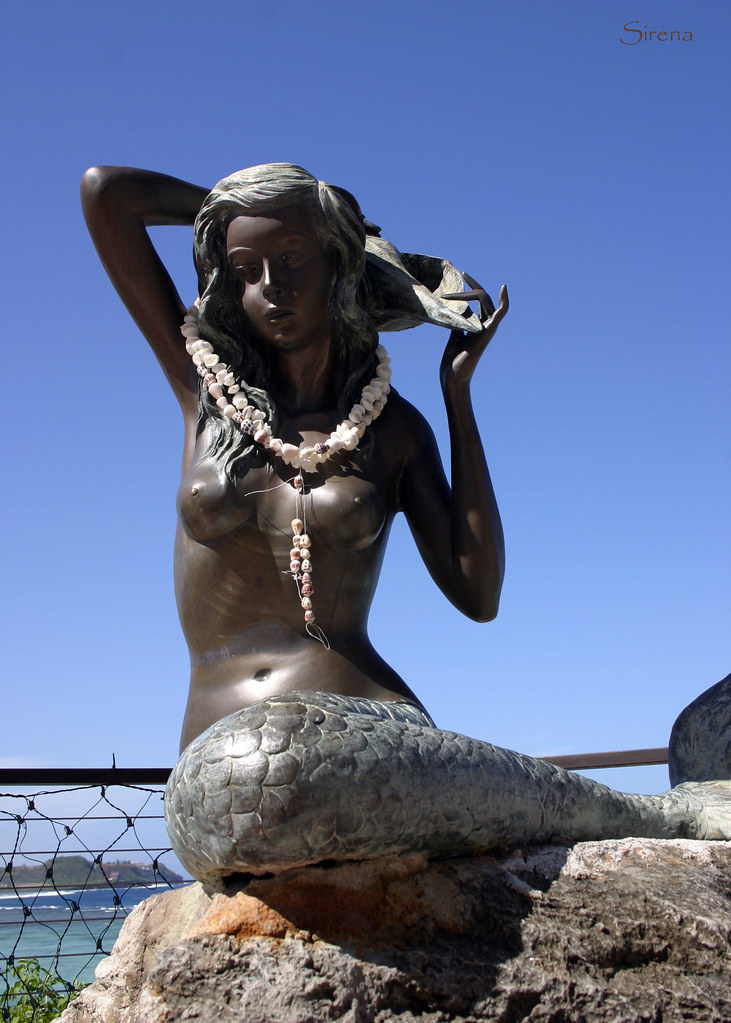
Goddess Series: Sirena


 This necklace is supposed to give the impression of Sirena (in fish form) swimming in dark waters and also be reminiscent of what a mermaid might wear.  I used nine glass turkish eye beads, various glass bugle and seed beads, fresh water pearls, blue goldstone, and aquamarine chips.  A silver tone clam shell also hangs from the back of the necklace, as a focal drop.

Image by Christine Magtoto
Sirena the Nine-Eyed Mermaid (or Nine-Eyed Fish) comes from the Honduras mythos.  She resides over rivers and lakes and is the keeper of the creatures that live there.  She is said provide respectful fishermen with fish and turtles.  It is believed that those who are not respectful of Sirena and the balance of life in her waters and/or who do not make the appropriate offerings will not be fruitful in catching fish and turtles.  In one story, she imprisons a man and a woman who were too greedy, forcing them to care for the creatures in her watery domains.

There are various stories regarding Sirena, both as a mermaid and as a large fish.  In Guam, there is a folk story about how Sirena was a young girl who was nearly obsessed with swimming in water, especially a river near her home.  One day, her mother sent her out to gather coconut shells/husks to use as fuel for their hearth.  When Sirena found herself near her beloved river, she forgot her task and spent the day swimming in the cool waters.  Her mother was upset and complained to Sirena's godmother, saying that her daughter must be swimming again.  In a fit of rage, her mother cursed her daughter, saying that if Sirena loved the water so much, she should become a fish.  Sirena's godmother quickly interjected that the part of Sirena that was promised to her should remain human.  And so, Sirena was transformed into a mermaid.  When her mother and her godmother searched for her and found her at the river, the mother saw what her words had done, but no matter how hard she tried to wish her curse away, her daughter remained a mermaid.  Sirena swam away and never was seen by her mother or godmother again.


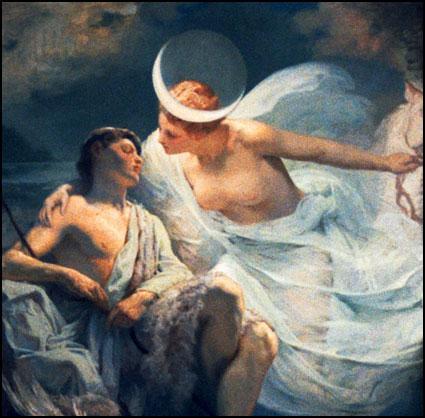
Goddess Series: Selene / Luna


This necklace is inspired by Selene's association to the moon and the ocean.  With silver tone wire I strung seashell pieces together that are black on one side and white on the other, giving the impression of the New Moon and the Full Moon.

Selene (also known in the Roman mythos as Luna) is the Goddess of the Moon, but also has connections with the night, the oceans, and more.  At night, she rose from the ocean and traveled across the night sky in her silver chariot pulled by two white horses.  She's also depicted as riding a horse or bull.  She's often shown wearing flowing robes, carrying a torch, and crowned with the crescent moon.


Goddess Series: Aphrodite


This necklace features tiny seashells, fresh water pearls, rose quartz chips, various glass beads, and a heart-shaped clasp.  I picture this would have been the type of necklace Aphrodite would have worn before she was ordered to marry Hephaestus, or something that one of her lovers or admirers would have given her.


Aphrodite is a well known Greek goddess; also known as Venus in the Roman mythologies.  The name "Aphrodite" means "sea foam", which comes from one of the stories of her creation.  The story told by Hesiod is what inspired this necklace.  In that tale, Ouranus (also known as Uranus, and father to the gods) was castrated by his son, Cronus.  Cronus disposed of the severed testes by throwing them into the ocean.  From the genitals of Ouranus and the foam of the sea, a woman was conceived.  She was fully developed from birth.  She was beautiful, nubile, and extremely sensual.

As most know, she is the representation of sexual rapture, beauty, and love.


Goddess Series: Kali Ma


This necklace takes inspiration from Kali Ma's outfit.  It features green dyed howlite skulls, which remind me of the heads Kali Ma wears as a necklace, and wavy metal drops which are reminiscent of the arms she wears as a skirt.  With the skulls are gemstones in varying shades of green, representing the earth that she both saved and nearly destroyed.  (Matching earrings were made to go with this necklace.  Images of them may be added at a later date.)

Kali Ma is a darker Hindu goddess whose name is derived from the Hindu words "time" and "black".  Though she is often referred to as the goddess of destruction, she was manifested from the need to protect the world from evil beings that the other gods were unable to overcome.  (Shiva was not able to be stirred from meditation, so his consort Pavarti was asked to help.  It was at this time that she became Kali Ma.)  As she slayed the invaders, she drank their blood, growing intoxicated in the process.  Unfortunately, she became consumed by her power and rage that after her adversaries were defeated, she continued her deadly dance, threatening to destroy the world she was trying to protect.  Her mate, Shiva, laid on the ground, beneath her stomping feat,  to save the earth from her destructive force.